Fixed fractional: let the stop decide the size
The most common professional method starts from the loss, not the position: decide what share of the account you are willing to lose if the stop is hit, then buy whatever size makes the stop cost exactly that. Position size = (account × risk per trade) ÷ (distance to the stop × point value), rounded down to a size you can actually trade. A wide stop means a small position; a tight stop, a big one. The risk stays the same.
The losing-streak table is the honest part. Losses compound on a shrinking balance, so ten 1% losses take 9.6%, not 10% — but ten 5% losses take 40%, and getting back from −40% needs a +67% gain. Streaks happen: with 50% winners, the chance of at least one run of ten losses in 250 trades is about 11%, and a run of seven is more likely than not (63%). How deep a normal bad stretch goes is the subject of our Monte Carlo drawdown article.
Volatility sizing: let the market's swings decide
Instead of a stop, volatility sizing scales the position to how much the market moves. A volatility target sizes the position so it swings like a chosen percentage a year: position value = account × target volatility ÷ the market's volatility. A market twice as volatile gets half the position. The ATR method is the one the Turtle traders used, described in the original Turtle trading rules published by former Turtle Curtis Faith: size each position so that a move of one average true range (N) changes the account by a fixed 1%. Both give every position a similar amount of risk, which is what makes a portfolio of different markets behave — the idea behind our portfolio math article.
Kelly: the biggest size that still makes sense
The Kelly criterion gives the share of the account to risk per trade that maximises long-run compound growth: Kelly = win rate − (1 − win rate) ÷ payoff ratio, where the payoff ratio is the average win divided by the average loss. It is a ceiling, not a target. Above it you take more risk and grow slower; at twice Kelly, growth is about zero.
Two facts make half Kelly the sensible maximum. In the standard continuous-time approximation (from Edward Thorp's work on the Kelly criterion), a fraction c of Kelly has a chance of x2/c − 1 of the account ever falling to x of its starting value: 50% for full Kelly to fall by half, 12.5% for half Kelly, under 1% for quarter Kelly. And half Kelly still keeps about three quarters of the growth. The table above runs the same trades through all four sizes, so you can see the drawdowns rather than take the formula's word for it.
The calculator assumes every win and every loss is its average, and that trades are independent. Real trades vary, and losses cluster — both push the right size lower still.
Download a free strategy
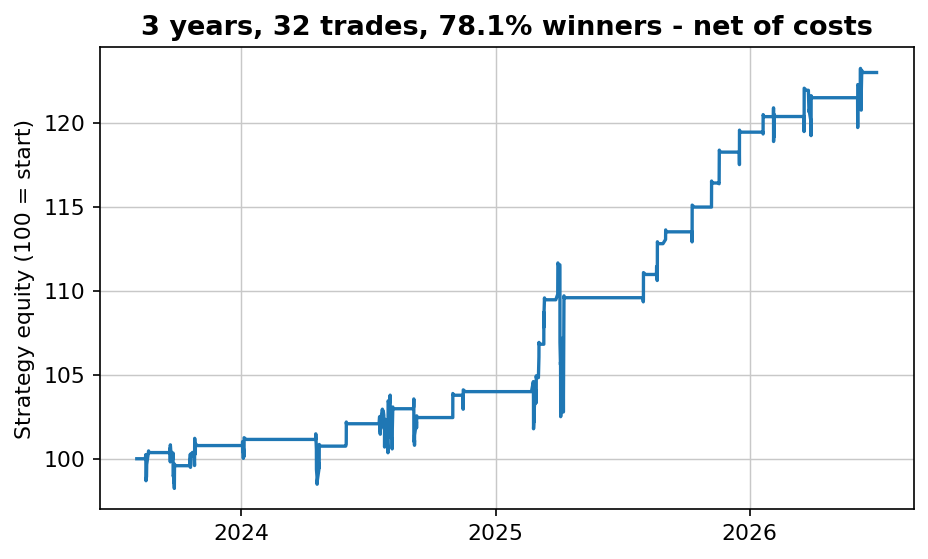
Position sizing only works with an honestly measured worst case. This strategy's is in the PDF, next to 70% winners across 155 trades over 16 years, net of costs. The free PDF gives you the market, the timeframe and the exact rules in plain English, plus every single trade it has taken.
Instant delivery. One PDF, no spam. Unsubscribe anytime.
FAQ
How do I calculate position size for a trade?
Decide how much of the account you are willing to lose if the stop is hit, then divide by what one unit loses at the stop: position size = (account × risk per trade) ÷ (distance to the stop × point value). A $50,000 account risking 1% ($500) on a stock with a $5 stop buys 100 shares; on Nasdaq futures ($20 a point) with a 20-point stop, one contract risks $400, so the answer is one contract.
What is the Kelly criterion in trading?
The Kelly criterion is the fraction of the account to risk per trade that maximises long-run compound growth: Kelly % = win rate − (1 − win rate) ÷ payoff ratio, where the payoff ratio is the average win divided by the average loss. With 55% winners and wins 1.2 times the size of losses, Kelly says risk 17.5% per trade — far more than most traders could live with.
Why use half Kelly instead of full Kelly?
Because the inputs are estimates. In the standard continuous-time approximation, full Kelly has a 50% chance of the account at some point falling to half its starting value; half Kelly keeps about three quarters of the growth and cuts that chance to 12.5%. And if your real edge is only half what the backtest says, full Kelly is really double Kelly, where growth falls to about zero.
How much should I risk per trade?
There is no number that is right for everyone, and this page is not advice. A common rule of thumb is 0.5% to 2% per trade. The losing-streak table shows what a choice means: at 1% per trade, ten losses in a row take about 9.6% of the account; at 5%, they take about 40%.
How does Turtle (ATR) position sizing work?
The Turtle traders sized every position so that a move of one average true range (N) changes the account by a fixed 1%: units = (1% of the account) ÷ (N × dollars per point), as described in the original Turtle trading rules published by former Turtle Curtis Faith. Volatile markets get smaller positions, quiet ones larger, so each position carries similar risk.