Simple, systematic trading strategies — tested and shown in full.
EdgeLab publishes rules-based strategies with the exact rules, honest backtests and the code — all shown. Every one is tested on data it has never seen before I publish it, so you can check it yourself before you trade it. Most of what I test fails. What's here didn't.
A few minutes a day
The strategies are in cash most of the time and act on one alert after the close. You check it in a few minutes, not all day.
Rules, not gut feel
Every rule is plain English. You always know why a trade opened and when it closes — no black box, no guessing.
Check it yourself first
Each strategy is tested on data it never saw, with every trade shown and the code included. Verify it, then decide.
Latest research
-
ICT Silver Bullet strategy: what 16 years of Nasdaq futures say about its win rate
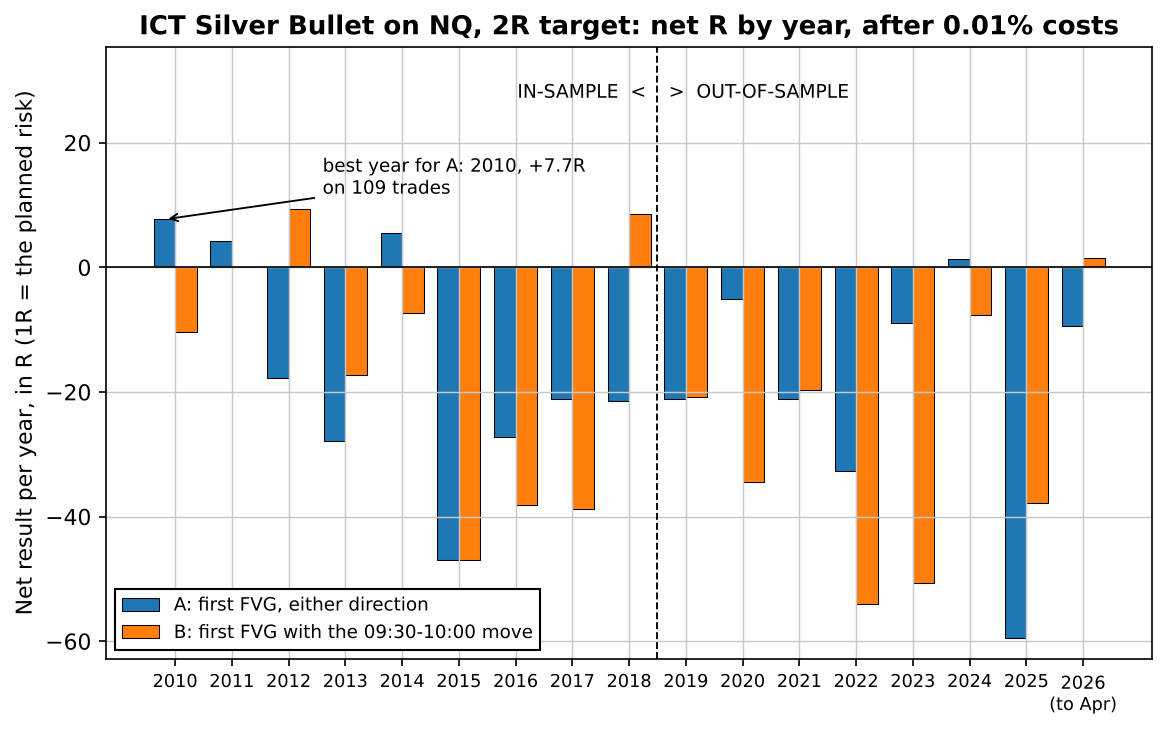
A mechanical ICT Silver Bullet, pre-registered and tested on 3,483 mornings of one-minute NQ futures. It wins about a third of the time at 2R and half at 1R, almost exactly the break-even rates. Before costs it earns zero; after costs both variants lose, and trading with the morning's direction made it worse.
-
Linda Raschke's Holy Grail trading strategy, tested: as written, it almost never trades
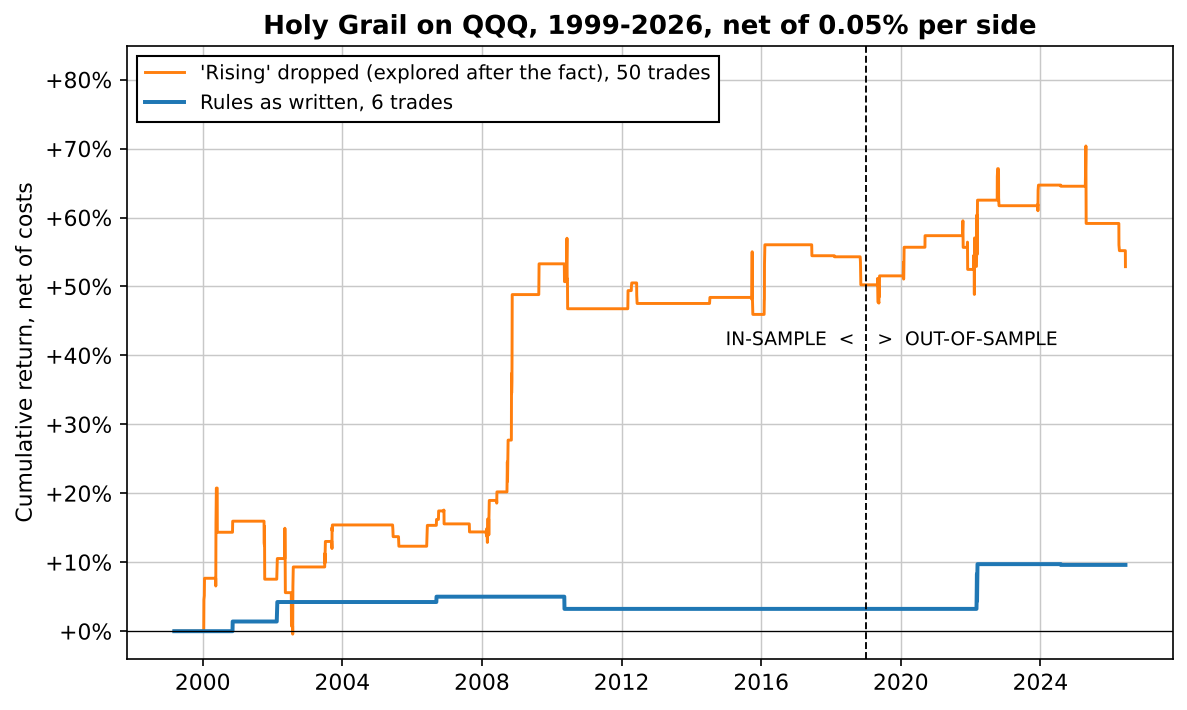
The Holy Grail pullback from Street Smarts, pre-registered and tested on QQQ, SPY, GLD and Nasdaq and gold futures. As written it found 19 setups in 113.8 market-years. Drop 'ADX rising' and QQQ trades 50 times: Sharpe 0.44 in-sample, 0.07 out-of-sample. Four of five markets fail the pass line, and the trailing stop doesn't rescue it.
-
Almost all of the Nasdaq's return happens while you sleep. Can you trade it?
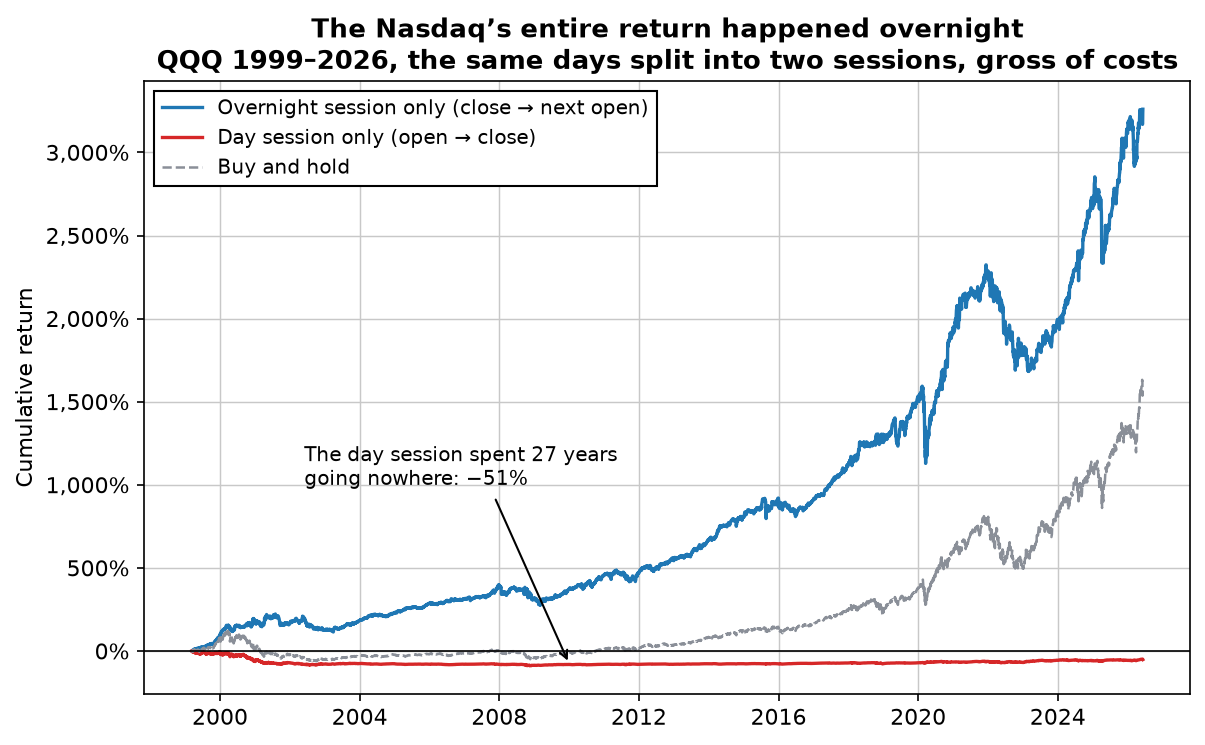
Split 27 years of QQQ into the hours the exchange is open and the hours it is closed: the overnight session compounded to +3,260% while the day session lost 51%. Trading it every night turns that into -96.5% after costs — the average night pays 5.5 basis points and a round trip needs to cost under 2.8. The selective version that survives: 584 trades, 56.7% winners, -18.7% max drawdown, 8.5% time in the market.
-
How to backtest a trading strategy in Python — and the four mistakes that inflate every result
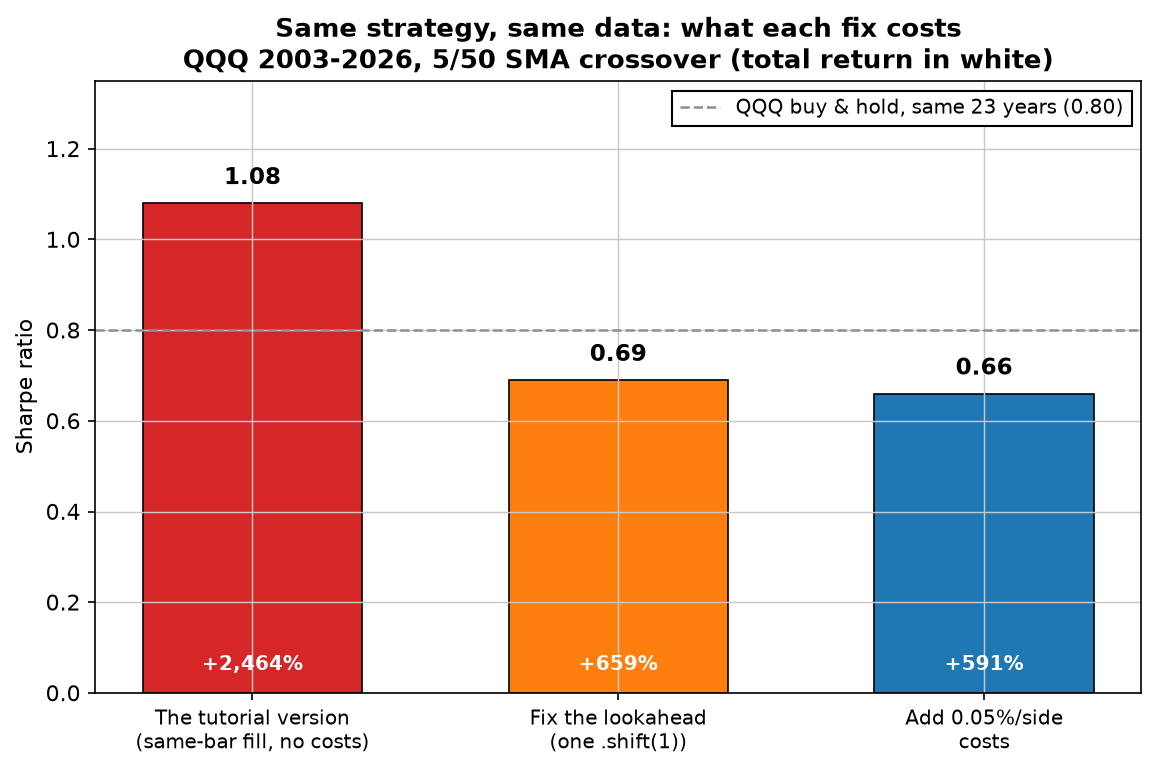
The same SMA crossover, written twice. The tutorial version returns +2,464% on QQQ with a Sharpe of 1.08. Fix the lookahead — one .shift(1) — and it is +659%. Add real costs, choose the parameters on held-back data, and the honest version loses to simply owning the index. Full reusable code, and the tuning step that scored worse than picking at random.
Download the free strategy
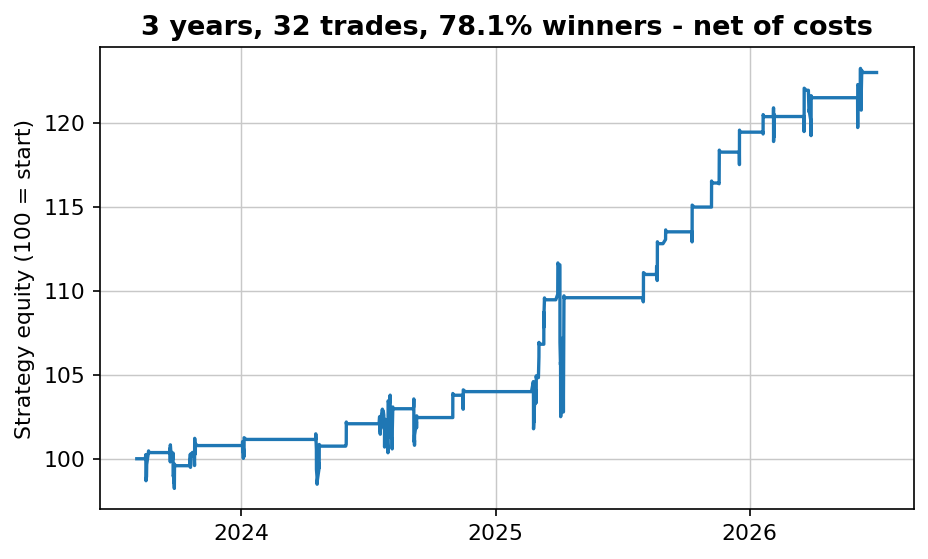
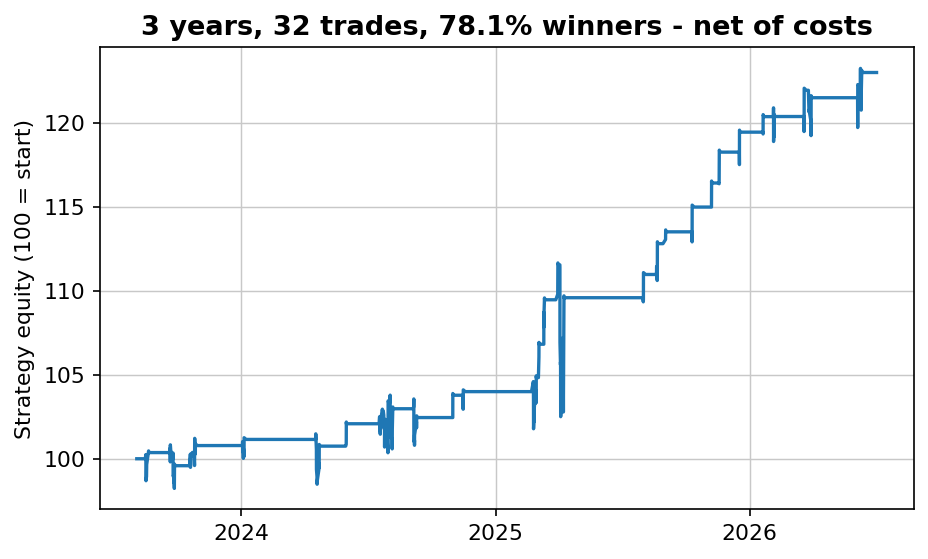
A simple RSI-based strategy with a handful of clear rules. Over 15.8 years it has taken 155 trades — 109 winners (70%) — with a worst drawdown of -11.5%, net of costs, and it earned more in the second half of that record than the first. It's in the market about 8% of the time: one alert does the watching, your capital sits safe between signals, and the markets get minutes of your day instead of owning it.
The free report gives you the market, the timeframe and the exact rules — in plain English, they fit on a sticky note — plus every single trade with timestamps, 23 years of long-run evidence for the idea, and the honest caveats. Nothing held back, nothing to buy first.
Download the free strategy
One PDF: the market, the timeframe, the exact rules — plus all 155 trades and what it honestly earns.
Instant delivery. One PDF, no spam. Unsubscribe anytime.
How we test
Every strategy published on EdgeLab has passed the same three filters:
- Out-of-sample validation. The most recent 20–30% of price history is locked away during development and used exactly once. If the strategy fails there, it's rejected.
- Sensitivity analysis. Every parameter is shifted ±20–30%. If the edge only exists at one magic setting, it's curve fitting — rejected.
- Monte Carlo simulation. Trade order is randomized across thousands of runs to stress-test drawdowns beyond what the historical sequence happened to produce.
And every backtest pays its way: we charge 0.05% per side in commission and slippage — roughly two to three times what a liquid ETF actually costs to trade at a decent broker. If an edge can't survive costs it will never pay in real life, so we'd rather understate every number on this site than flatter one.
More than 80% of the strategies we develop are rejected. Here's why that rejection rate is the whole point →
Who's behind this
I'm Robin Eriksson. I spent my first five years in the markets losing money on gut feel and chart patterns — steadily, a good month then two bad ones — before systematic trading turned it around. The real change wasn't a better indicator; it was that the markets stopped owning my evenings, and drawdowns became something I'd already met in testing instead of a reason to lie awake. Trading was supposed to buy freedom. Systematic is the version that actually did. EdgeLab is where I publish the research. More about me and the methodology →