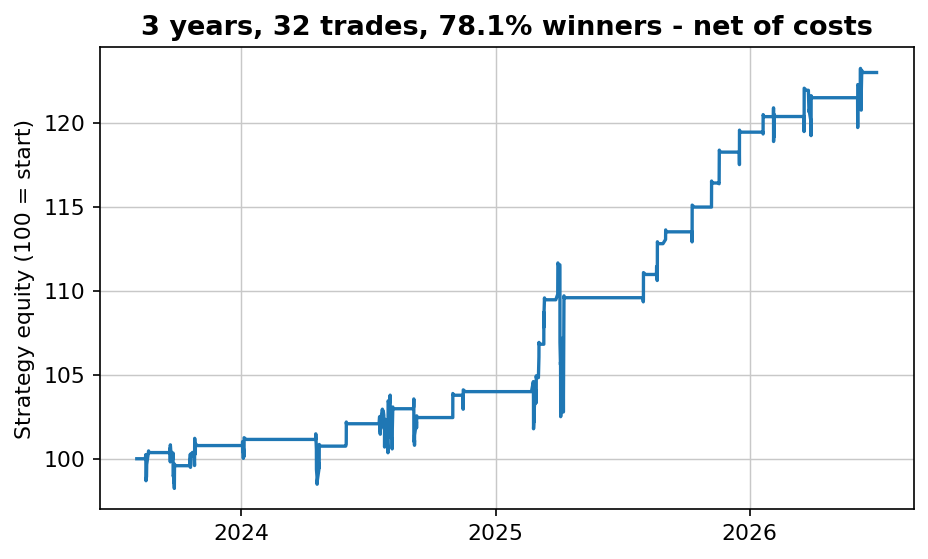
The short version: buy QQQ when RSI(14) hits 30, sell at 40. On the 2-hour chart — the video's timeframe — that produced 155 trades in 15.8 years: 109 winners (70.3%) with a -11.5% worst drawdown, net of costs, and the second half of that record beat the first. On the daily chart the same rules fired 32 times in 23 years and won 28 (since 2014: 18 of 19). The catch on both: time in market is tiny, so raw compounding is modest — this is a precision tool, not a complete system. The faster RSI(2) daily variant compounded 9.7% a year with a third of buy-and-hold's drawdown. All the data below.
The rules — all of them
- Buy QQQ at the close when the 14-day RSI is at or below 30.
- Sell at the close when RSI(14) is back at or above 40.
Long only, no leverage, no stop-loss, no filters. That's genuinely the whole thing. RSI(14) below 30 is rare on a diversified index — it takes a real panic — which is exactly why the signal is worth waiting for. In practice you set one alert and get on with your life; the market will tell you when it's time, roughly once or twice a year.
Every signal since 2003
Here is every entry the strategy has ever generated on daily QQQ data, net of 0.05% commission per side. Not a sample — all of them:
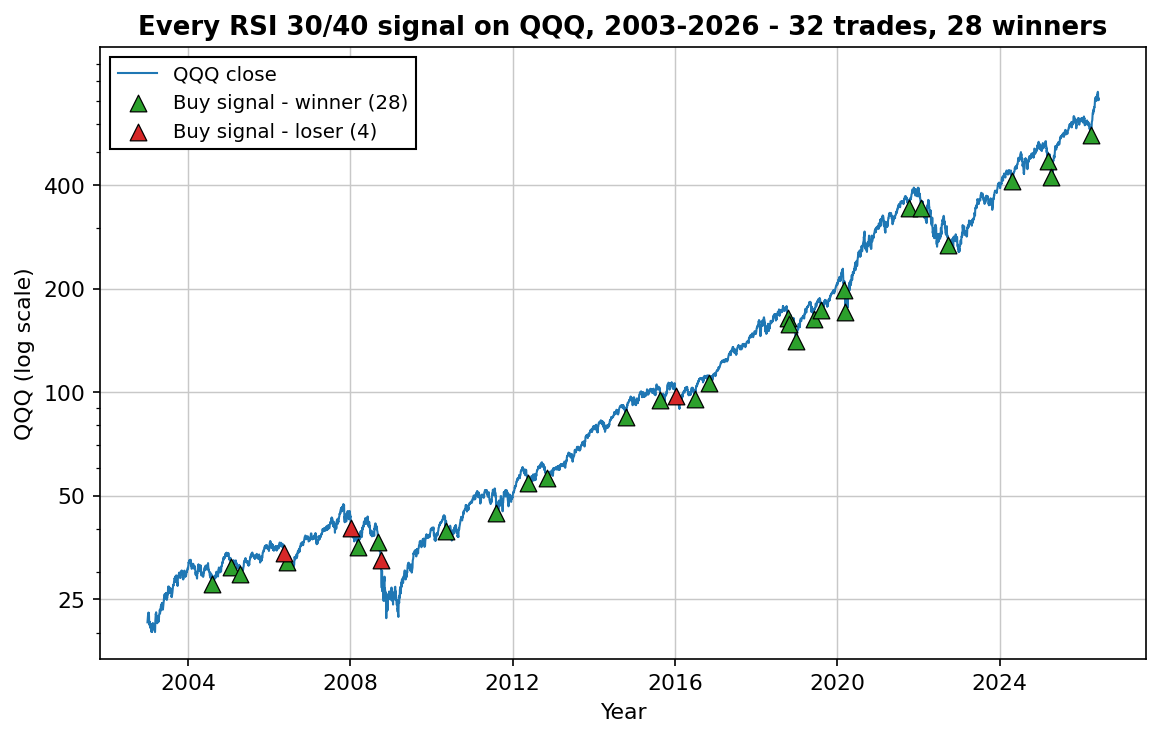
And because an equity curve can hide a lot, here is the full trade log. Most strategy sellers won't show you this; we think it's the only honest way to present a rare-signal system:
| # | Entry | Exit | Days held | Return |
|---|---|---|---|---|
| 1 | 2004-08-06 | 2004-08-17 | 7 | +1.55% |
| 2 | 2005-01-24 | 2005-01-31 | 5 | +2.28% |
| 3 | 2005-04-15 | 2005-04-21 | 4 | +2.43% |
| 4 | 2006-05-16 | 2006-06-01 | 11 | -0.40% |
| 5 | 2006-06-12 | 2006-06-15 | 3 | +3.24% |
| 6 | 2008-01-08 | 2008-02-01 | 17 | -2.93% |
| 7 | 2008-03-10 | 2008-03-11 | 1 | +3.70% |
| 8 | 2008-09-09 | 2008-09-19 | 8 | +1.03% |
| 9 | 2008-09-29 | 2008-10-28 | 21 | -15.84% |
| 10 | 2010-05-07 | 2010-05-10 | 1 | +5.09% |
| 11 | 2011-08-08 | 2011-08-11 | 3 | +4.86% |
| 12 | 2012-05-17 | 2012-05-29 | 7 | +1.93% |
| 13 | 2012-11-08 | 2012-11-19 | 7 | +0.88% |
| 14 | 2014-10-15 | 2014-10-20 | 3 | +2.08% |
| 15 | 2015-08-21 | 2015-08-27 | 4 | +3.06% |
| 16 | 2016-01-07 | 2016-01-22 | 10 | -1.15% |
| 17 | 2016-06-27 | 2016-06-28 | 1 | +2.09% |
| 18 | 2016-11-04 | 2016-11-07 | 1 | +2.27% |
| 19 | 2018-10-10 | 2018-10-16 | 4 | +3.09% |
| 20 | 2018-10-24 | 2018-10-25 | 1 | +3.36% |
| 21 | 2018-12-21 | 2018-12-26 | 2 | +3.51% |
| 22 | 2019-06-03 | 2019-06-05 | 2 | +3.48% |
| 23 | 2019-08-05 | 2019-08-08 | 3 | +4.06% |
| 24 | 2020-02-27 | 2020-03-02 | 2 | +5.14% |
| 25 | 2020-03-12 | 2020-03-24 | 8 | +3.69% |
| 26 | 2021-10-04 | 2021-10-06 | 2 | +1.90% |
| 27 | 2022-01-21 | 2022-01-31 | 6 | +3.13% |
| 28 | 2022-09-26 | 2022-10-04 | 6 | +2.73% |
| 29 | 2024-04-19 | 2024-04-23 | 2 | +2.41% |
| 30 | 2025-03-10 | 2025-03-19 | 7 | +1.62% |
| 31 | 2025-04-04 | 2025-04-09 | 3 | +10.14% |
| 32 | 2026-03-30 | 2026-03-31 | 1 | +3.28% |
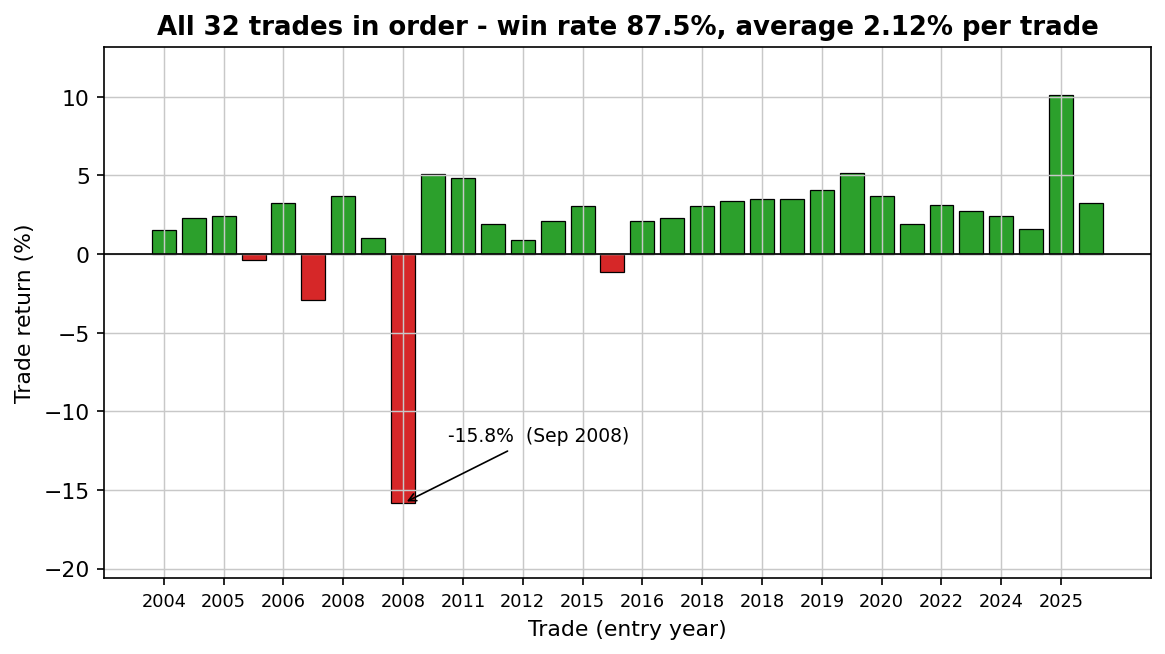
Study row 9 before anything else. That's the September 2008 entry: RSI said "panic, buy" — and the panic kept going for 21 trading days and -15.8%. No stop-loss means when the exception comes, you ride all of it. That trade is the strategy's honest price tag, and something like it will happen again. (Row 31 is the other side of the same coin: the April 2025 tariff crash, +10.1% in three days.)
The honest part: what it earns on its own
An 87.5% win rate sounds like a money machine, so let's do the arithmetic the sales pages skip. The strategy is in the market 2.8% of the time. Thirty-two trades averaging +2.12% over 23 years compounds to roughly 2.8% a year — far less than buy-and-hold's 16.1%. That's not a flaw in the test; it's what "rare and precise" means. You're being paid a remarkably high rate per day of risk taken, but there aren't many of those days.
So judge it as what it is: a tactical component. It waits for the handful of days each year when the Nasdaq is genuinely washed out, takes the bounce, and hands your capital back. The other 97% of the time that capital is free — free to sit safe, or free to run other strategies that make money in different ways. That framing matters more than any single number in this article, and it's where the portfolio math takes over.
The 2-hour timeframe: the video's version, over 16 years
Free 2-hour QQQ data only reaches back about three years — 32 trades, which is a sample, not evidence. So we went and got the long history: NQ (Nasdaq-100 futures), same 09:30–16:00 session, back to June 2010. Same index, same rules, 15.8 years. That gives 155 trades — 109 winners (70.3%), average +0.52% per trade, median +0.81%, worst single trade -6.33%, max drawdown -11.5%, in the market 7.6% of the time. Net of 0.05% per side. About 10 signals a year instead of one or two: the same edge, ten times the opportunities.
Split the record in half and the second half is the better one: 2018 onwards — data the rules were never shaped on — gave 81 trades, 70.4% winners and 6.3% a year, against 70.3% and 3.7% in the first half. Sixteen of seventeen calendar years were profitable. Whatever this is, it did not decay over sixteen years.
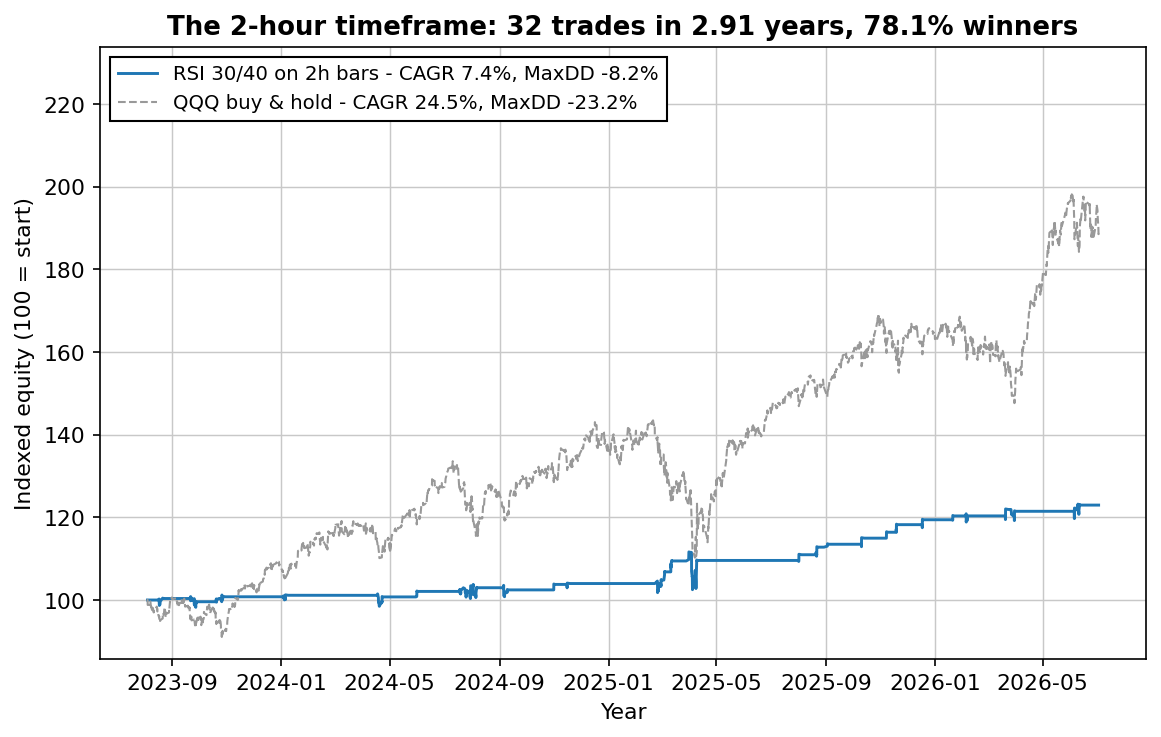
Buy & hold made far more money over the same window — 17.8% a year against 5.1%. It also asked you to sit through a -36% drawdown to get it. This strategy's worst was -11.5%, holding a position 7.6% of the time:
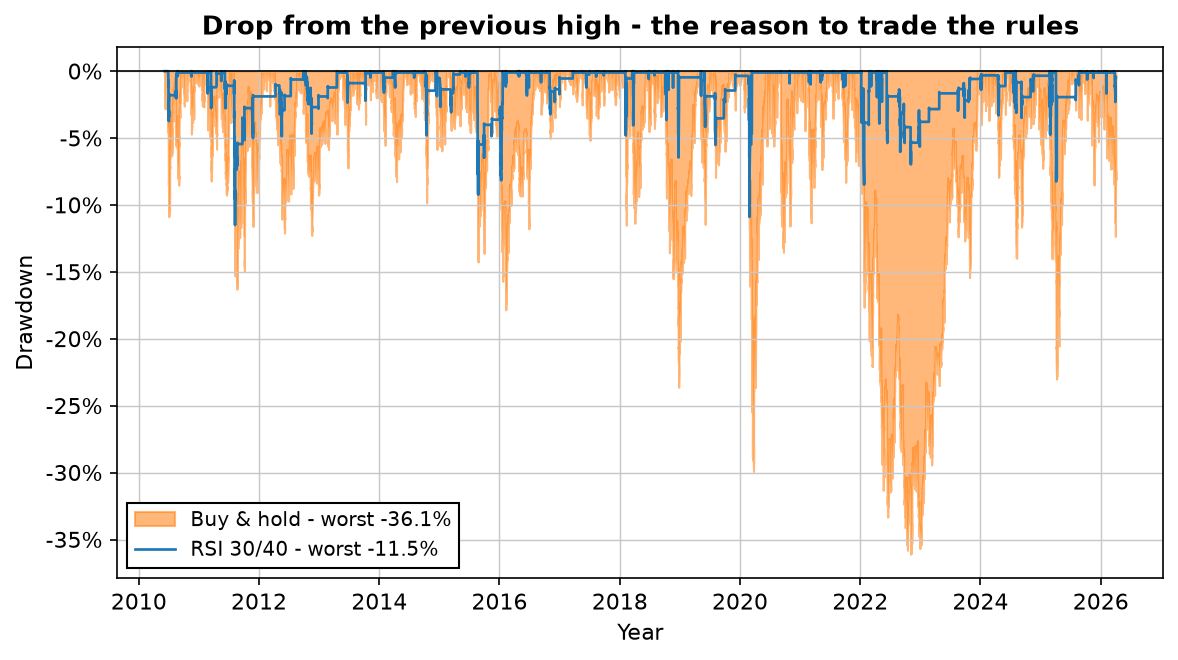
Three honest notes. The 2-hour history is measured on futures, not on the ETF — QQQ is still what you trade, NQ is what makes a 16-year intraday test possible. We checked the substitution rather than assuming it: over the window where both exist the two move together at 0.9921 correlation bar-for-bar, and the identical rules produced 30 trades on QQQ against 29 on NQ with the same -8.2% max drawdown. NQ reads slightly more conservative (72.4% winners against QQQ's 76.7%), so the long-run numbers here are, if anything, the cautious version. Second, we ran the identical rules on 1-hour bars: 46 trades, 65% winners, 3.1% a year — clearly worse. Faster is not better; 2-hour bars filter the noise that 1-hour bars trade. On weekly bars the signal fires a handful of times per decade — skip it.
Want more signals? The fast variant: RSI(2)
Keep the thresholds, swap the lookback: a 2-day RSI instead of 14. Same logic — buy short-term panic, sell the recovery — but the 2-day RSI dips to 30 roughly once a week instead of once a year. That turns a rare tactical signal into something that can actually carry an account:
| Metric | In-sample 2003–2013 | Out-of-sample 2014–2026 | QQQ buy & hold (full) |
|---|---|---|---|
| CAGR | 6.6% | 12.6% | 16.1% |
| Sharpe ratio | 0.52 | 0.92 | 0.80 |
| Max drawdown | -18.0% | -16.5% | -53.4% |
| Trades | 346 | 383 | — |
| Win rate | 69.1% | 71.5% | — |
| Time in market | 30.7% | 27.2% | 100% |
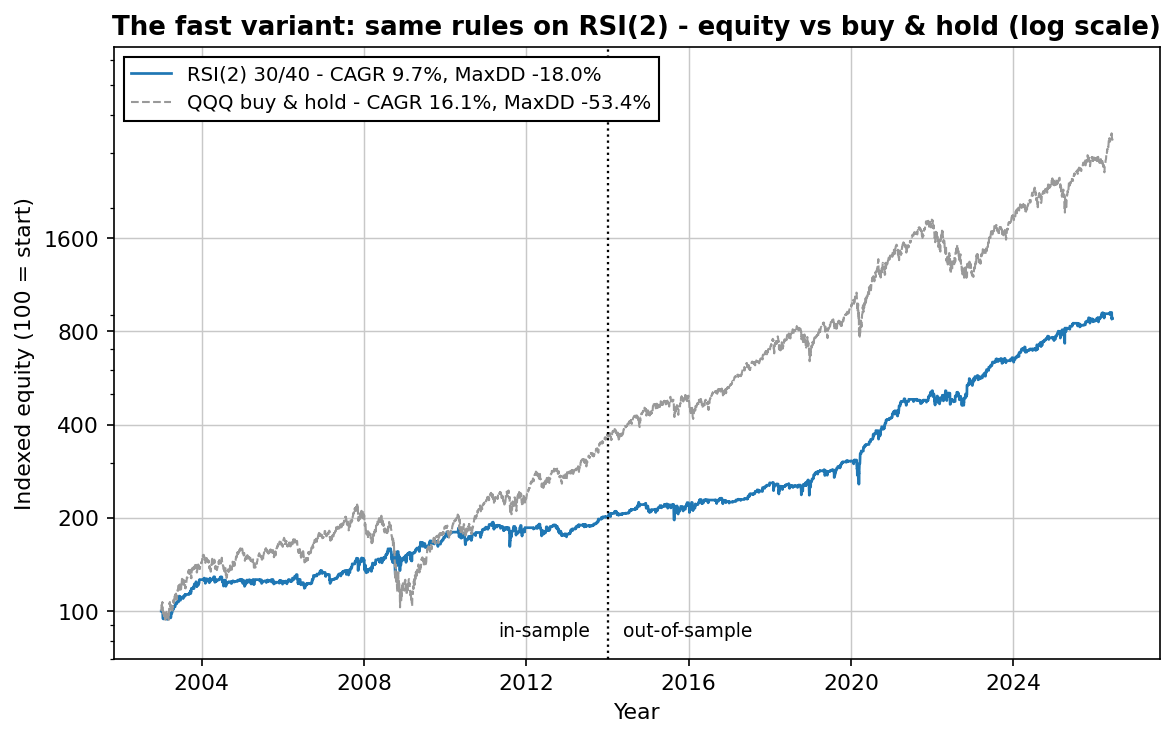
Read the table like a skeptic, the way we read every backtest: the out-of-sample decade was better than the in-sample one (0.92 vs 0.52 Sharpe) — the opposite of what curve fitting looks like. The honest cost: ~2-day holds mean commissions and slippage matter, and the numbers above already charge 0.05% per side. If your execution is materially worse than that, your results will be too. This is the same strategy family as our full dip-buying grid test, where the edge held across every neighboring parameter — a plateau, not a lucky number.
Where it fits: one strategy is a tactic, not a system
Both versions of this strategy do exactly one thing: buy stock-index panic. In a year when stocks bleed slowly without panicking — or panic and keep falling — they will have a bad year, no matter how good the entry rule is. The way simple strategies become an account is not adding rules; it's combining a few that make money in different ways, so that when one bleeds, another is working. The portfolio math is here — one formula, and correlation is the whole game.
Download the free strategy report
Everything in this article as one PDF — the rules, all 155 trades with timestamps, the fast variant, the honest numbers. Ready to set one alert and run.
Instant delivery. One PDF, no spam. Unsubscribe anytime.
FAQ
What is the RSI 30/40 strategy?
Buy QQQ at the close when the 14-day RSI is at or below 30; sell at the close when it's back at or above 40. Long only, no leverage, no other rules. 32 signals in 23 years, 28 winners, ~5 trading days per trade.
Does the RSI strategy work on the Nasdaq?
As a tactical dip signal, measurably yes: 28 of 32 historical signals profitable net of costs, 18 of the last 19. But it's in the market only 2.8% of the time, so standalone it compounds at ~2.8% a year — a high-quality component, not a complete system.
Should I use RSI(2) or RSI(14)?
Same idea, different speeds. RSI(14): once or twice a year, 87.5% win rate. RSI(2): roughly weekly, 9.7% CAGR over the full sample (12.6% out-of-sample) with a -18% max drawdown versus -53% for buy-and-hold. Pick by the job you need done.
Does it work on 2-hour charts?
Yes — verified over 15.8 years: 155 trades with 109 winners (70.3%), a -11.5% max drawdown and about 10 signals a year, net of costs. The long history is measured on NQ futures because free 2-hour QQQ data only goes back three years; the two agree at 0.9921 correlation where they overlap. The identical rules on 1-hour bars were clearly worse (65% winners, 3.1% a year) — 2-hour bars appear to be the sweet spot.

Robin Eriksson
Founder of EdgeLab. Five years of discretionary losses taught me to test everything — now I publish the strategies that survive. About me →
Related: Buying the dip in QQQ: 23 years of evidence, net of costs · Does Connors' RSI(2) still work? We tested it on the Nasdaq · The Turnaround Tuesday strategy — rules and 23 years of backtest data