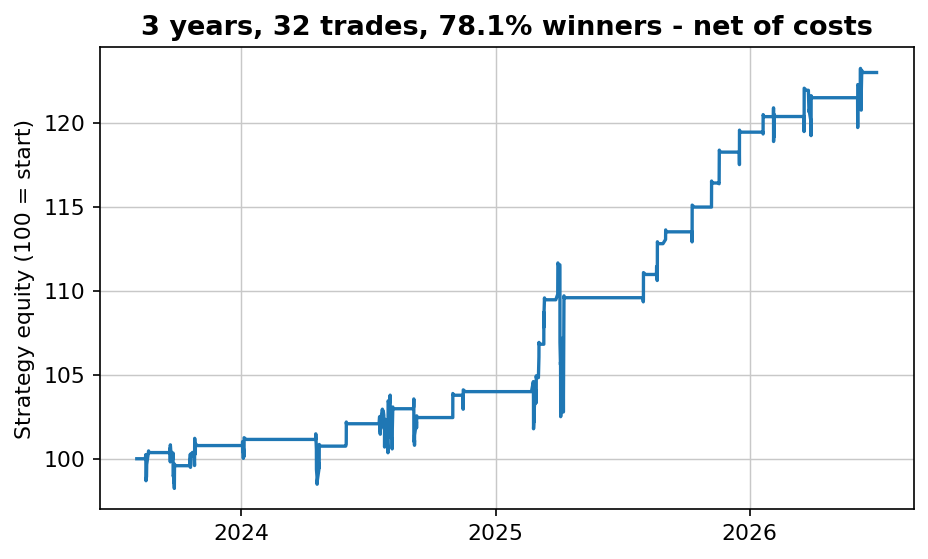
The short version: Darwinex Zero is a subscription platform (from €45/month) where you trade a virtual account under real market conditions to build a verified, investable track record. There's no challenge to pass and no daily-loss tripwire — instead, a risk engine normalizes every track record to the same volatility, which makes risk-adjusted return the only thing you're selling. That's ideal for patient, multi-strategy systematic traders — and a poor fit if you want fast payouts from one aggressive strategy.
What it actually is
The model in one paragraph: you pay the subscription, trade a virtual account with live market prices on MetaTrader 4 or 5 (manually or with EAs — automation is explicitly allowed), and your performance becomes a public, verified index called a DARWIN. Each month, the DarwinIA program allocates notional capital to the best-behaved DARWINs — the April 2026 round distributed roughly €48.5M across about 1,400 track records in the Silver tier, an average in the €35k range — and you keep 15% of the profits made on whatever capital follows you. Behind it sits Darwinex, an FCA-regulated broker that has run the same model with real-money accounts since 2012.
So: no evaluation, no "pass in 30 days", no rule that closes your account because Tuesday went badly. The trade-off is equally clear — nobody hands you $100k of simulated buying power on day one either. You're building an asset slowly, not renting one quickly.
The detail that changes everything: the risk engine
This is the part most reviews mention in passing and most traders misunderstand. Every DARWIN is normalized to the same risk target — 6.5% monthly value-at-risk, roughly 14% annualized volatility. If your underlying account runs hotter than that, investors get a scaled-down version. Calmer, and they get a scaled-up one. Your position sizing stops determining investor risk; the engine equalizes it.
Which means the only thing left to compete on is return per unit of risk:
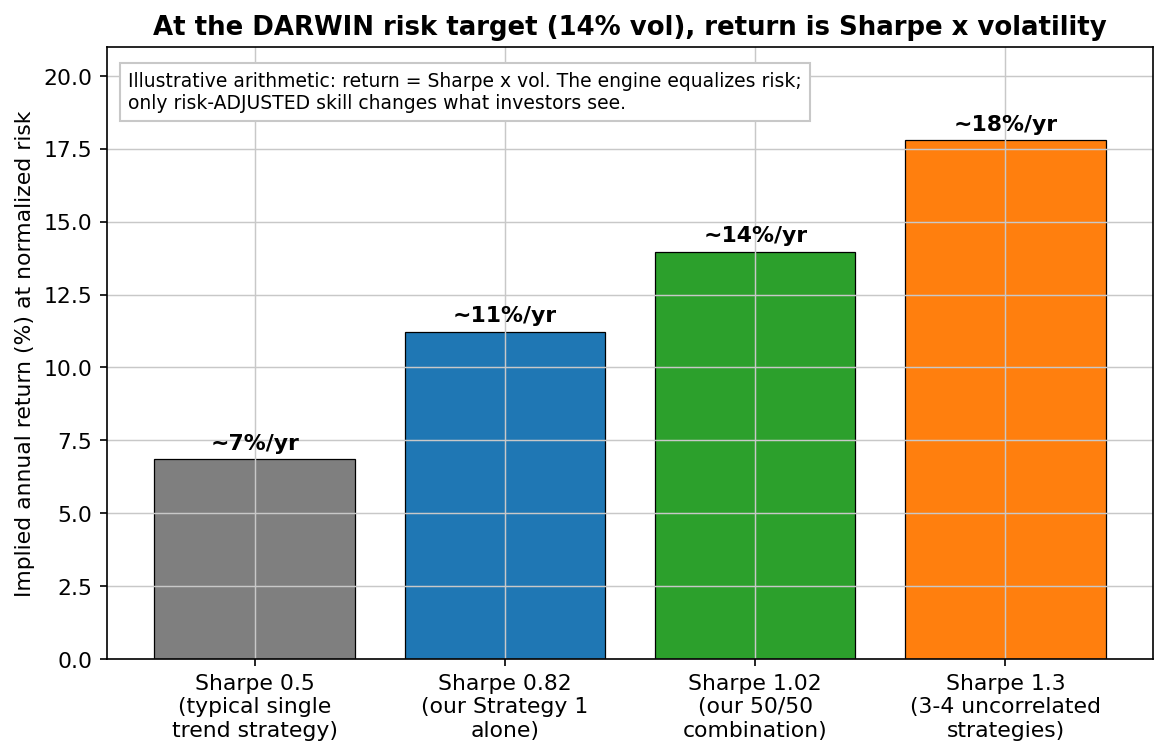
For systematic traders this flips the usual marketing logic on its head. A flashy 40%-a-year strategy with wild swings becomes a mediocre DARWIN. Meanwhile the thing we bang on about constantly — combining uncorrelated strategies to lift Sharpe while giving up little return — translates one-for-one into a better product on this platform. Our own public example: Strategy 1 alone runs a 0.82 Sharpe; paired 50/50 with an uncorrelated gold strategy it's 1.02. At the DARWIN risk target, that's the difference between ~11% and ~14% a year on investor capital. The portfolio effect isn't a nice-to-have here. It's the whole game.
The honest math on €45 a month
The subscription is small but real — €540 a year — and you should know exactly what has to happen before performance fees cover it:
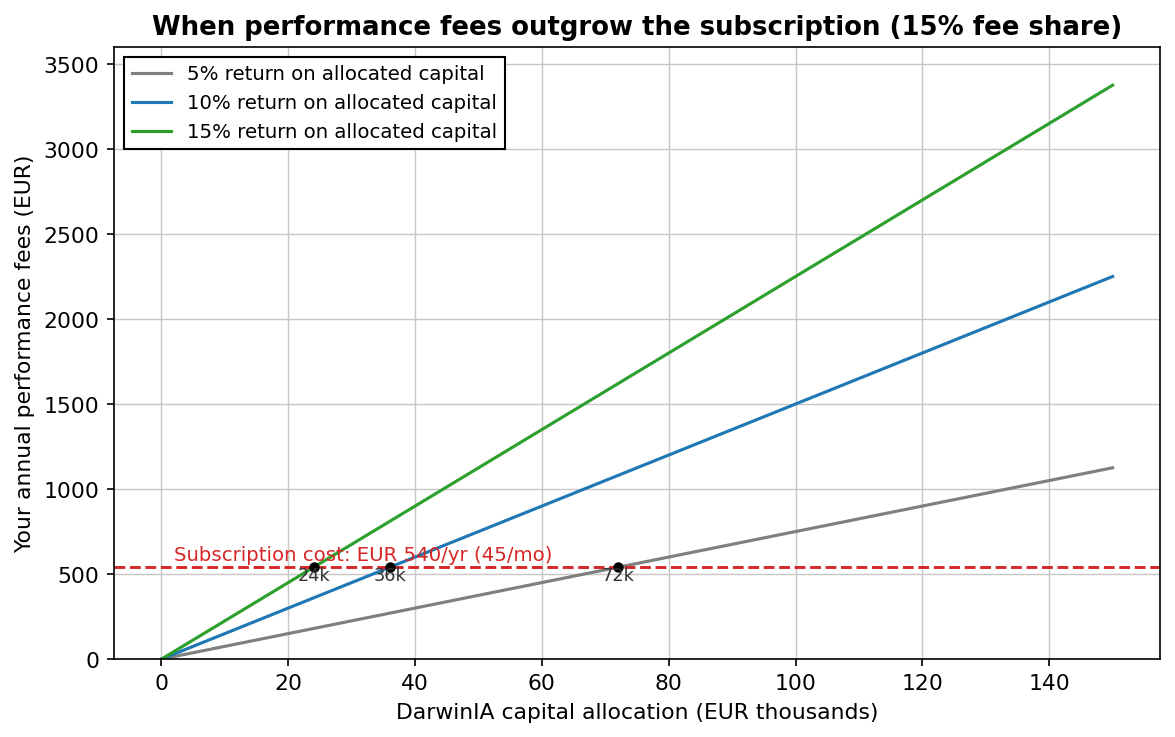
Reaching a DarwinIA allocation in the tens of thousands is realistic — that's what the average Silver-tier allocation looks like — but it requires months of consistent, risk-controlled performance first. So treat the first year's €540 as what it is: the cost of producing a verified track record, the one credential in this industry that can't be photoshopped. The alternative way to prove the same thing is trading €50k of your own money in public. The subscription is cheaper.
Darwinex Zero vs a prop firm challenge
| Darwinex Zero | Typical challenge firm | |
|---|---|---|
| Entry | Subscription, no evaluation | Pay per attempt, pass 8–10% target |
| Daily loss limit | None | ~5% — one bad day ends it |
| Time pressure | None | Often 30–60 days per phase |
| Overnight / weekend holds | Allowed | Often restricted |
| Automation | Allowed (MT4/MT5 EAs) | Varies, often restricted |
| Payout model | 15% of profits on allocated capital | 80–90% splits, faster but conditional |
| What kills you | Impatience — the model is slow | Tripwire rules, even with a real edge |
The split is honest on both sides. If you trade intraday with tight risk control and want income this quarter, a challenge firm's 80–90% split beats 15% — if you survive the rules. If you run daily-timeframe systematic strategies — the kind that hold through a 5%-down day because the backtest says that's Tuesday — challenge rules will eventually execute you for doing exactly what your system requires. We've run the Monte Carlo on that, and it deserves its own article.
The caveats nobody puts in affiliate reviews
- Allocations are competitive, not guaranteed. DarwinIA rewards consistency and risk control; a few flat months happen to every real strategy, and they push the allocation out in time. Budget for the subscription accordingly.
- The risk engine cuts both ways. Discretionary traders who express conviction through position size lose that lever entirely — the engine undoes it. You must be comfortable with skill being measured one way: risk-adjusted.
- Trading conditions are real. Spreads and commissions apply as on a live account. A strategy that only works at zero cost dies here exactly like it would anywhere else — as it should.
- 15% is slow money. Even a great year on a mid-size allocation is hundreds of euros, not thousands. The asset being built is the track record and the path to scale — not next month's invoice.
The strategies are the hard part — start with a free one
A platform is just plumbing. What gets allocated capital is a high-Sharpe, multi-strategy track record — and that starts with robust, simple strategies. Get the free strategy report: the market, the timeframe and the exact rules in plain English, every trade shown — ready to run on any platform including MT5.
No spam. Unsubscribe anytime.
FAQ
Is Darwinex Zero a prop firm?
Not in the challenge sense: no evaluation, no daily-loss rule, no time limits. You subscribe, build a verified track record on a virtual account with real market conditions, and earn 15% of profits on capital allocated to it.
Can you run EAs and algos?
Yes — MT4/MT5 automation is allowed, as are overnight and weekend holds and slow timeframes. It's one of the few capital routes that doesn't quietly punish systematic trading.
How much can you realistically earn?
Run the breakeven chart before subscribing: 15% of profits on allocated capital means a €36k allocation earning 10% covers exactly one year's subscription. Early on, the product is the track record; the income follows scale, slowly.
Who should pick a challenge firm instead?
Intraday traders with tight daily risk who want large simulated capital and fast payout splits — and who can genuinely live inside a 5% daily-loss rule. For daily-timeframe systems, the math usually points the other way.

Robin Eriksson
Founder of EdgeLab. Five years of discretionary losses taught me to test everything — now I publish the strategies that survive. About me →
Related: SPY vs QQQ vs gold vs bitcoin: the best asset, risk-adjusted · Does the 200-day moving average work? Tested on five assets · When is a strategy dead? Three statistical tripwires we use