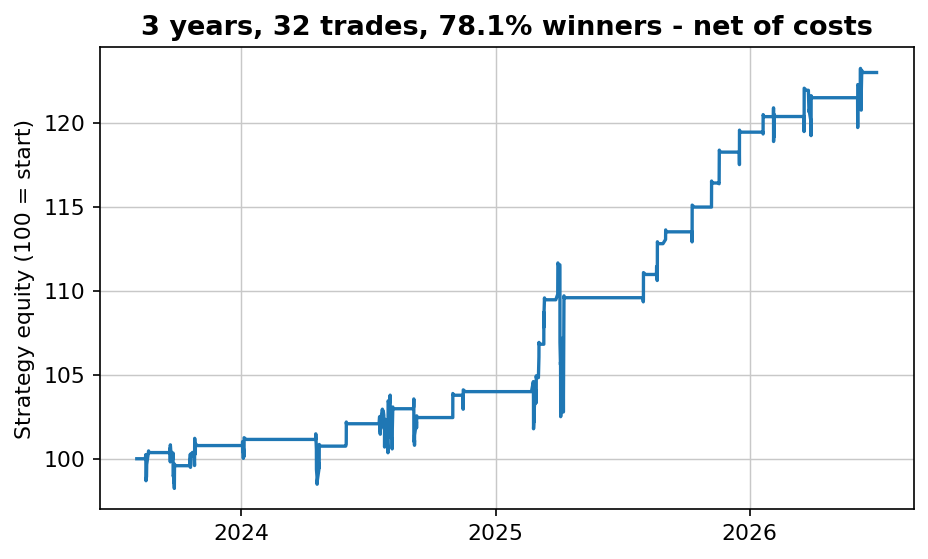
Classic book strategies make the best test subjects there are. Their rules are written down, fixed and public — often decades before the data we test them on. The years since publication are a genuine out-of-sample test that nobody could have fitted, not even the author.
How we test them: the rules come from the original source — the book, and the page where we can — and are written down before the backtest runs. Then the house rules: costs on every trade; stop entries filled at the open when the market gaps through the trigger, which is the rule that sinks many breakout setups from the books; the later years held out; and every number generated by the article's own script. The lists below are rebuilt from those results whenever a new test is published.
The pattern so far: the mean-reversion classics have aged well and the pattern setups have not. Connors' RSI(2) family is alive on the Nasdaq on every timeframe we tried. Most of the setups from Street Smarts and other books, Turtle Soup included, failed our research-log bar. And classic trend following is real but needs far more markets than a retail account can hold — which is why the original Turtles traded dozens of them.
What held up
-
Does Connors' RSI(2) still work? We tested it on the Nasdaq
Connors' RSI(2) dip-buying is alive on daily, 2-hour and 4-hour Nasdaq bars, net of costs. It isn't dead, just crowded.
Works Connors TPS scale-in: Sharpe 0.72 in-sample, 0.78 out-of-sample, max drawdown -11.6%
Works RSI(3) dip-buying with trend filter: Sharpe 0.61 in-sample, 0.72 out-of-sample, max drawdown -13.6%
Works RSI(3) dip-buying with trend filter: Sharpe 0.37 in-sample, 0.63 out-of-sample, max drawdown -14.1%
Works Connors RSI(2) with 200-day filter: Sharpe 0.68 in-sample, 0.56 out-of-sample, max drawdown -13.4%
-
Buying the dip in QQQ: 23 years of evidence, net of costs
Nearly every oversold threshold and holding period we tried was profitable: a plateau, not a lucky setting. It earns most of the return with far less exposure, not more return.
Works RSI(2) below 30, exit above the prior high: Sharpe 0.82 over the full test, max drawdown -19.5%
What failed
-
The Strategy Graveyard: we stress-tested 150+ trading strategies — most didn't survive
Most strategies we screen fail our bar, and most of those aren't dead, just duplicates of edges we already own.
Failed Classic book setups (Street Smarts, DeMark, Kaufman, Chande): 17 variants tested, 0 passed the bar.
Failed Trend following, Carver-style acceleration: 20 variants tested, 0 passed.
Failed Trend following, Clenow-style core panel: 24 variants tested, 0 passed: real, but needs far more markets than a retail account holds.
Failed Turtle Soup (Street Smarts): 4 markets tested, 0 passed; walk-forward mean Sharpe between -0.04 and -0.4.
Written down, waiting to be tested
These tests are pre-registered: the rules, the data and what counts as failure were fixed before any backtest ran. Working titles; the result is published either way.
- Linda Raschke's Holy Grail setup, tested on 16 years of Nasdaq and gold
- The original Turtle Trading rules in 2026: do they still work?
- Turtle Soup: Raschke's fade of the breakout, and ICT's version, tested
- Larry Williams' volatility breakout on Nasdaq futures, with honest fills
See all 9 of these results side by side on the scoreboard.
By topic: Nasdaq · Gold · ICT concepts · Classic books · All of them: the scoreboard
Download a free strategy
Simple and robust — 70% winners across 155 trades over 16 years, net of costs. The free PDF gives you the market, the timeframe and the exact rules in plain English, plus every single trade it has taken.
Instant delivery. One PDF, no spam. Unsubscribe anytime.
FAQ
Do the Turtle trading rules still work?
The original rules — Donchian breakouts with volatility-based position sizing — get a full test of their own, listed on this page once it is published. The wider family we have already measured: in our research log, trend following on a single market came out with a low Sharpe ratio and needed a broad futures panel to become an account. That is why the Turtles traded so many markets at once.
Does Larry Connors' RSI(2) strategy still work?
Yes, modestly. On sixteen years of Nasdaq futures it stayed profitable out-of-sample on daily, 2-hour and 4-hour bars, net of costs. What changed is how crowded it is: it barely diversifies a book that already buys dips. The full test has every timeframe.
What is Linda Raschke's Holy Grail setup?
A trend-pullback entry from Street Smarts, the book she wrote with Larry Connors: when the ADX says a trend is strong, wait for price to pull back to the 20-period exponential moving average, then enter as it turns back with the trend. Our test of it, on Nasdaq and gold, was written down before it ran and is listed on this page.
Why do so many classic book setups fail today?
Three reasons keep coming up: they were published with in-sample results only; they ignored costs, which matter more the more often a setup trades; and their stop entries assumed fills at prices the market gapped straight through. A setup that survives all three is rare — and worth knowing about.
Is there a PDF of these strategies?
Each new test ships with its own PDF of the exact rules plus Python code. The book remains the source, and every article cites it.